
Three Questions I Ask Before Every Fixed Income Investment.
Because "they're telling stories" is not a return strategy.
We’ve all heard it. Someone worked hard, saved up, put their money somewhere that promised good returns — and when it was time to collect, they got excuses. Delays. Stories.
That scenario is almost always avoidable. And the way to avoid it is by asking the right questions before investing not after.
Here are the three questions every fixed income investor should run through before committing a single naira.
Question One: Who is the borrower, and can they actually pay back?
Here’s something important to understand first: fixed income investing is lending. When money goes into a fixed deposit, it is a loan to the bank. When someone buys a government bond, they are lending money to the government. When capital goes into a commercial paper, credit is being extended to a company. The investor is the lender — always think of it that way.
So the first question is simple — does this borrower have the capacity to pay back?
Willingness and capacity are two very different things. Someone can want to pay back and simply not have the money. Good intentions don’t settle obligations.
The spectrum of borrowers goes something like this — from safest to riskiest: federal government → commercial banks → blue chip companies → mid-size companies → small businesses → loan sharks. As you move down that spectrum, the capacity to repay becomes a bigger and bigger question.
Government borrowing is the benchmark. When the government borrows in its own currency, the capacity question is almost irrelevant — they can always print money to pay you back. However, when the government borrows in a foreign currency (like a Eurobond), that calculus changes and you need to pay closer attention.
Banks and blue chip companies have track records. Their financial statements are public. Regulators watch them. The smaller you go, the harder it is to assess capacity — and the harder you need to look.
Question Two: How long will the money be gone?
The technical word for this is tenor — the length of time between when the investment is made and when the capital comes back.
This matters more than most people realise. A seven-year bond with an attractive yield sounds great — until that cash is needed six months in and there is nothing that can be done about it. The money is locked. That is not an investment problem — that is a planning problem.
Here’s a quick guide to the terminology so you’re never confused:
Less than one year + government borrowing = Treasury bill
Less than one year + corporate borrowing = Commercial paper
More than one year + government borrowing = Treasury bond
More than one year + corporate borrowing = Corporate bond
Before committing, the honest question to ask is: is there comfort in not having access to this money for the full tenor? If the answer is no — or even maybe — either pick a shorter instrument or keep that portion liquid.
Question Three: Does the return justify the risk?
This question comes last deliberately. Because if the capital doesn’t come back, the return is irrelevant.
Once it’s established that the borrower can pay back and the timing works, then — and only then — assess whether the return makes sense for the risk being taken.
The principle is simple: the riskier the borrower, the higher the return should be. If government Treasury bills are yielding 18% and a blue chip company offers 21% — that spread makes sense for the additional risk. But if a relatively unknown company offers 15% while government paper is at 18%, something is wrong. More risk for less return. Walk away.
This framework also applies to products that might not immediately look like fixed income. Take agric investment funds — the ones that say “give us ₦20,000 for six months and we’ll pay you 20%.” Before thinking about the farm or the produce, the first question is: who is the entity behind this? Do they have the capacity to pay back if anything goes wrong — a bad harvest, a logistics problem, a market collapse? Because the investor doesn’t own the produce itself. There is simply an obligation from a company to pay back at a certain date. That company’s financial health is what’s really being bet on...
ONGOING CLUB DEALS


The Three Questions, Summarised
Who is the borrower, and do they have the capacity to pay back?
What is the tenor, and is there comfort in being without that cash for that period?
Does the return match the risk?
Apply this framework every time — whether the instrument is a Treasury bill, a fixed deposit, a corporate bond, or an agric fund.
🎯 Want to go deeper on this?
This is exactly the kind of thinking unpacked in the Personal Finance Lab — practical, no-jargon financial education built for people who are serious about making their money work.
Building a full picture of how to analyse investments, construct a portfolio, and make decisions that hold up under pressure — that is what the course is for.
The Lab covers:
How to structure investments across currencies and asset classes
Understanding macro factors that drive inflation
Building portfolios that profit from economic volatility
Long-term wealth strategies beyond just “beating inflation”
This Week's Nugget: Meeting Mr. Market.
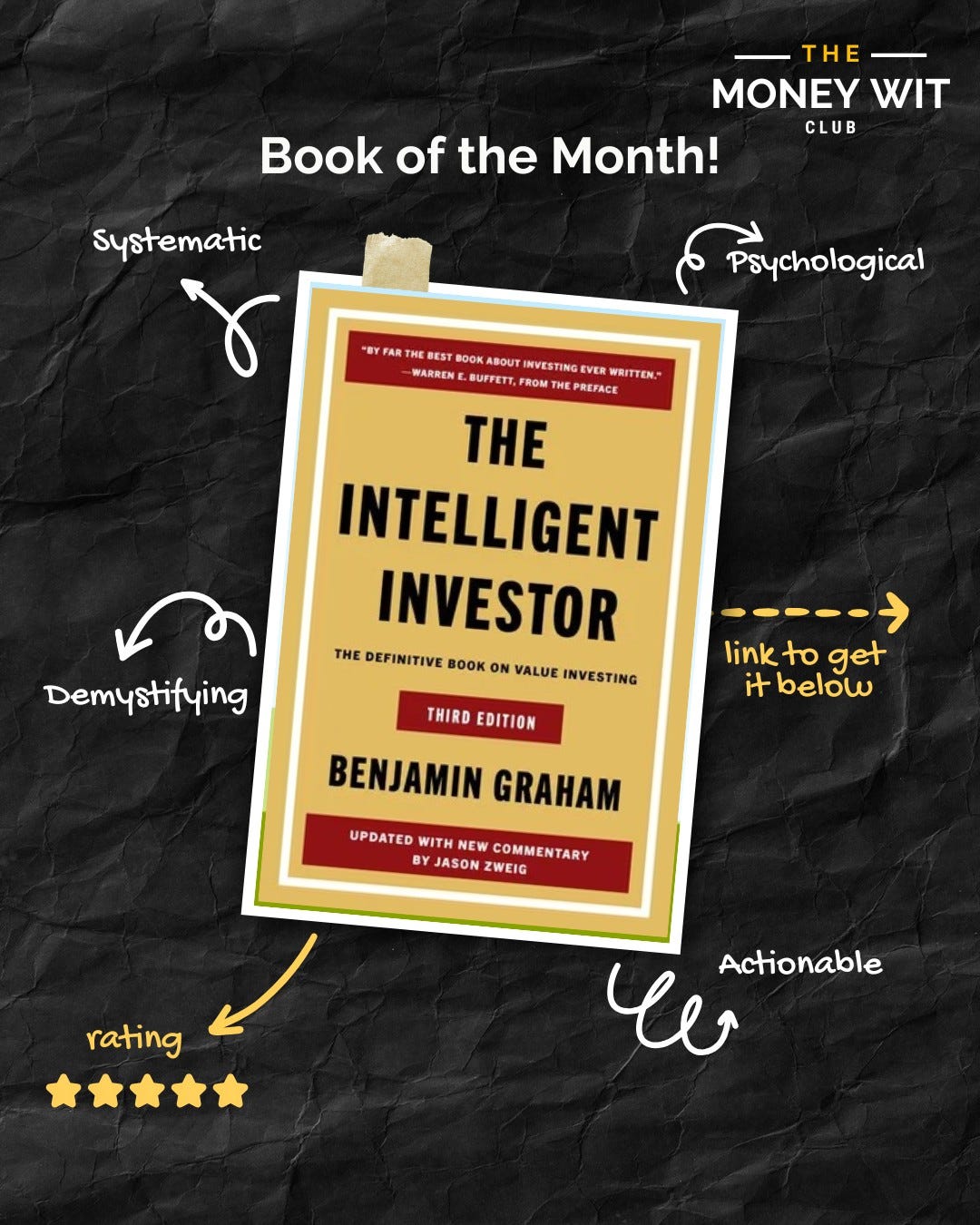
This week’s excerpt:
Emotional detachment. Mr. Market is your business partner who offers to buy you out or sell you his share every day at different prices.
The Nugget: Mr. Market is there to serve you, not to instruct you. His manic-depressive swings (green days and red days) are opportunities, not signals of a company’s actual health.
Action: When the market drops this week, don’t ask “Why is it falling?” Ask “Is this business now on sale?
Get the Book Here and let’s discuss!!
HOW WE HELP YOU WIN WITH MONEY:
Because financial freedom isn’t luck; It’s a learnable skill.
FOR INDIVIDUALS
LEARN - Master the fundamentals that matter
• Beat The Odds Workshop – Learn how the top 1% think about money and markets
• Personal Finance Lab (PFL) – Build the systems that create lasting wealth
CONNECT - Join Nigeria’s sharpest money minds
• The Money Wit Club – Full community access plus personal guidance and accountability
GROW - Get the personal support that moves the needle
FOR CORPORATES
PARTNER - Strategic collaboration that drives impact
• CSR Sponsorship – Partner with us on financial literacy initiatives that matter
• Custom Corporate Programs – Tailored financial education designed for your organization
• Brand Partnership – Connect with our engaged community of 5000+ finance enthusiasts.
Ready to level up? Send us an email via info@themoneywitclub.com.
What’s happening in the club?
Images from our 2025 EOY Party!!


< NEW YOUTUBE VIDEO ALERTWe have a new YouTube video on our channel that breaks down “ Why High Earners Stay BROKE! (and How to Break Free from Paycheck to Paycheck Living)”
Are you a high earner wondering why your bank balance never reflects your income? You’re not alone! Many successful professionals find themselves trapped in a paycheck-to-paycheck cycle, despite earning significant amounts.
You’ll discover:
The #1 Culprit: How lifestyle inflation silently erodes your financial security, even with a rising income.
Cash Flow Chaos: The hidden dangers of poor money management and why tracking your spending is crucial.
🎯 Want to know the rest? Watch the full video to get the full list and start investing smarter today.
Watch, learn, and share with a friend.
Did you enjoy reading this? Help spread the message by forwarding to at least 10 of your contacts.
Was this email forwarded to you? Subscribe here.
We host weekly money discussions live on our YT channel… visit our channel
Want to advertise with us? Email business@oleroladele.com
At the Money Wit Club, we provide you with opportunities to invest in high-value companies with the potential to help you yield the highest returns on your investments. Watch full interview here.
Join the Money Wit Club today.
Until next week,
Oler.