
How to Recognize a Ponzi Scheme Before It Takes Everything.
High returns. No risk. No product. Here is what to look for before the money disappears.
Nigeria’s economic environment has made Ponzi schemes more dangerous than ever. When the economy is under pressure, when inflation is eating savings, when people are looking for any edge they can find — that is precisely when fraudulent investment schemes thrive. The desperation is real. And the schemes are designed to exploit it.
Here is a clear breakdown of what a Ponzi scheme actually is, how to identify one, and what the warning signs look like before the money is gone.
What a Ponzi Scheme Actually Is
A Ponzi scheme is not an investment. It is a fraud dressed up as one.
In a legitimate investment, money goes into a business or asset that generates returns — the business sells something, earns revenue, and shares a portion of that profit with investors. In a Ponzi scheme, there is no business. There is no underlying product generating returns. The only source of payment to existing investors is the money coming in from new investors.
The people who enter early get paid. The people who enter late get nothing — because at some point, the inflow of new money cannot keep pace with the payments owed, and the whole structure collapses. The last people in lose everything.
Why People Fall for Them
The scheme works because it looks like it works — at first.
A person puts in ₦100,000 and receives ₦50,000 the next month. Then another ₦50,000 the month after. The capital has come back. They tell a friend. The friend invests. The friend gets paid. The story spreads.
Nobody questions how a business generating those returns still needs more money from the next investor. Nobody asks why, if the returns are real, the operator keeps accepting new capital. The early experience of receiving payments overrides the logic of questioning the model.
This is compounded by one of the most powerful forces in financial decision-making: the fear of missing out when others appear to be profiting.
The Red Flags — What to Look For
High return with guaranteed safety
In investing, high return is always the reward for high risk. That is not a theory — it is the foundation of how markets work. If someone offers a return that sounds extraordinary and simultaneously claims there is no risk to the capital, one of two things is true: they are lying about the return, or they are lying about the risk. Either way, that combination does not exist in any legitimate investment.
The moment those two claims appear together — exceptional returns and zero risk — treat it as a red flag.
No regulatory license
For any entity taking money from the public for investment purposes, regulation is not optional. In Nigeria, that means an SEC license — not a business registration number, not a corporate affairs commission certificate, not a physical office in a prestigious address. An SEC license. It can be verified directly on the SEC’s website.
Ponzi schemes will not have one. They may show business registration documents. They may show office addresses. They will not show a valid SEC investment management or fund management license. If the license cannot be verified, the risk is unquantifiable — and almost certainly not worth taking.
No visible, real product
Some Ponzi schemes dress themselves up as product-based businesses — claiming to sell consumer goods, agricultural products, or physical commodities. The tell is always the same: the product cannot be found anywhere. Not in major retailers, not in local markets, not in the hands of actual users. Pictures exist. Testimonials exist. But the product itself does not show up in the real world.
If a business claims to sell something but that thing cannot be seen, bought, or verified by anyone independently — that is a red flag.
Returns that simply do not add up
A business that can reliably pay 50% monthly returns does not need outside investors. If the model genuinely generated those returns, the operator would fund it entirely from internal profits. The fact that new capital is continuously being solicited is itself the signal that the returns are not being generated by any real business activity.
Ponzi Schemes vs. Network Marketing vs. Bad Investments
These three are frequently confused. The distinctions matter.
Network marketing involves selling a real product and recruiting others to sell the same product. The income comes from actual sales. The product exists, can be purchased independently, and is verifiable in the market. Not all network marketing is high quality, but the structure is fundamentally different from a Ponzi scheme.
A bad investment is not fraud. A transport business that launched in February 2020 and immediately faced COVID lockdowns had real assets, real plans, and real misfortune. Businesses go through bad patches. Central bank policy changes can alter the viability of entire sectors overnight. The best intentions can and do go wrong. Losing money in a real business is painful — but it is not the same as being defrauded.
A Ponzi scheme is fraud from the first day. There is no business. There is no plan to generate returns from any real activity. It exists solely to collect money from new entrants and redistribute it to earlier ones — until it collapses.
ONGOING CLUB DEALS


What to Do With the Money Instead
Leaving savings in a bank account feels safe. It is not.
Ten years ago, ₦80,000 could buy ten bags of rice. Today, the same ₦80,000 buys two. That erosion is not dramatic — it is quiet, consistent, and cumulative. Inflation is the tax on money that is not invested. It collects every year, whether or not the account holder is aware of it.
The answer to avoiding Ponzi schemes is not to avoid investing altogether. It is to invest in regulated, verifiable instruments — mutual funds, treasury bills, bonds, equities — where the underlying asset is real, the returns are proportionate to the risk, and a regulator is watching.
Start small if necessary. Get educated first. But do not leave money idle while inflation works against it quietly.
The guiding principle for every investment decision is straightforward: if the return does not make sense, if the product cannot be seen, if the regulator cannot confirm the license — slow down. That pause is worth more than any promised return.
🎯 Learn how to invest with confidence
Knowing what to avoid is only half the picture. The Personal Finance Lab covers the full framework — how to identify legitimate investment opportunities, how to assess risk, and how to build a portfolio that actually grows wealth over time.
There are two things that cannot be outsourced — health and personal finances. Nobody can invest wisely on anyone else's behalf. The knowledge has to be personal.
This Week's Nugget: Know what you own.
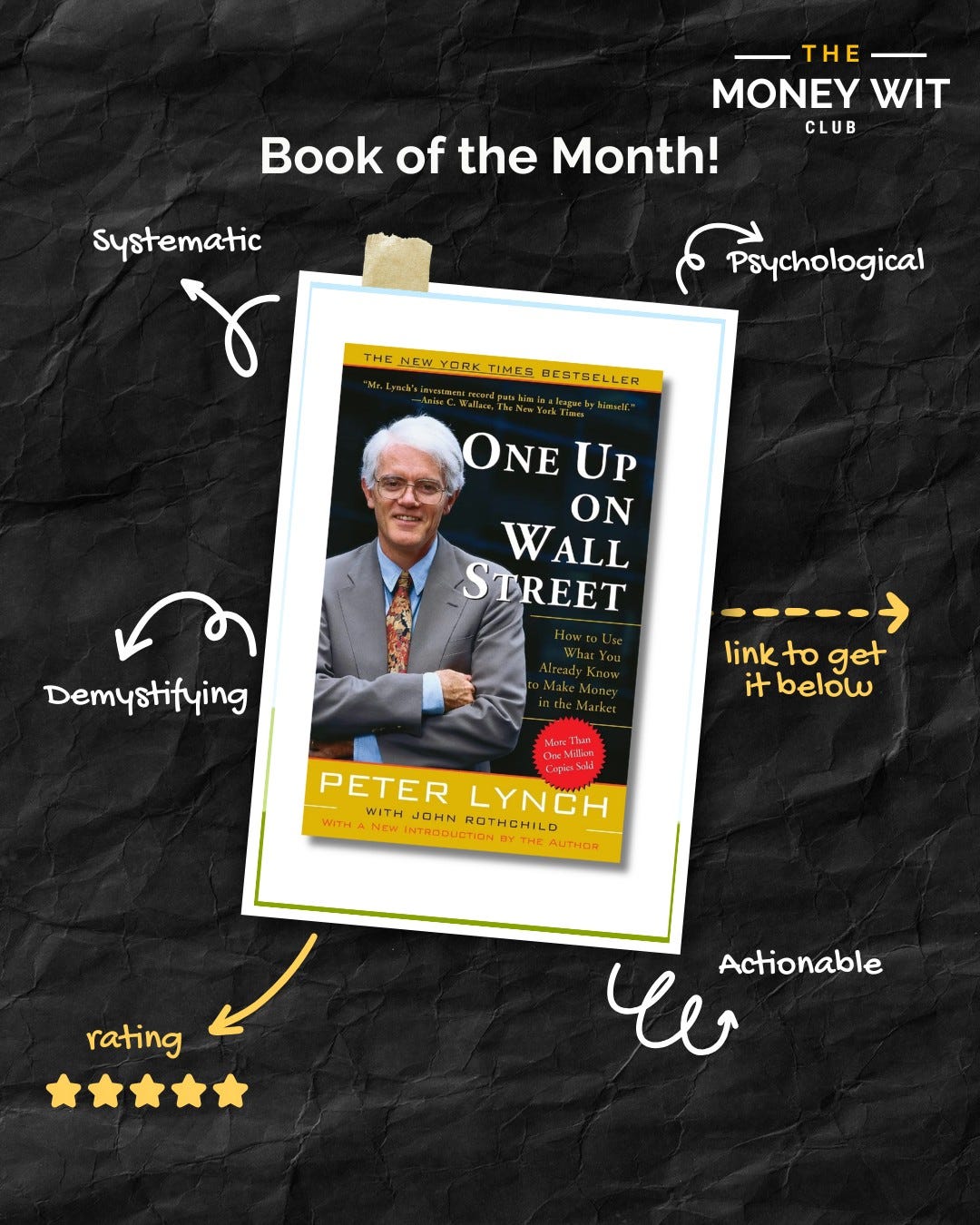
This week’s excerpt:
Know what you own, and know why you own it.
The Nugget: Lynch categorised stocks into six types — from slow growers to fast growers to turnarounds. Knowing which type you own tells you exactly what to expect and when to sell.
Action: Pick one stock you own or are watching. Honestly classify it using Lynch's six categories. Does your return expectation match the category? Adjust your thesis accordingly?.
Get the Book Here and let’s discuss!!
HOW WE HELP YOU WIN WITH MONEY:
Because financial freedom isn’t luck; It’s a learnable skill.
FOR INDIVIDUALS
LEARN - Master the fundamentals that matter
• Beat The Odds Workshop – Learn how the top 1% think about money and markets
• Personal Finance Lab (PFL) – Build the systems that create lasting wealth
CONNECT - Join Nigeria’s sharpest money minds
• The Money Wit Club – Full community access plus personal guidance and accountability
GROW - Get the personal support that moves the needle
FOR CORPORATES
PARTNER - Strategic collaboration that drives impact
• CSR Sponsorship – Partner with us on financial literacy initiatives that matter
• Custom Corporate Programs – Tailored financial education designed for your organization
• Brand Partnership – Connect with our engaged community of 5000+ finance enthusiasts.
Ready to level up? Send us an email via info@themoneywitclub.com.
What’s happening in the club?
Images from our 2025 EOY Party!!


< NEW YOUTUBE VIDEO ALERTWe have a new YouTube video on our channel that breaks down “ Why High Earners Stay BROKE! (and How to Break Free from Paycheck to Paycheck Living)”
Are you a high earner wondering why your bank balance never reflects your income? You’re not alone! Many successful professionals find themselves trapped in a paycheck-to-paycheck cycle, despite earning significant amounts.
You’ll discover:
The #1 Culprit: How lifestyle inflation silently erodes your financial security, even with a rising income.
Cash Flow Chaos: The hidden dangers of poor money management and why tracking your spending is crucial.
🎯 Want to know the rest? Watch the full video to get the full list and start investing smarter today.
Watch, learn, and share with a friend.
Did you enjoy reading this? Help spread the message by forwarding to at least 10 of your contacts.
Was this email forwarded to you? Subscribe here.
We host weekly money discussions live on our YT channel… visit our channel
Want to advertise with us? Email business@oleroladele.com
At the Money Wit Club, we provide you with opportunities to invest in high-value companies with the potential to help you yield the highest returns on your investments. Watch full interview here.
Join the Money Wit Club today.
Until next week,
Oler.