
CBN’s New Dividend Lockdown: Why Access Bank is Skipping Your Payout
Here is what you need to know about this week's Global news review and how it affects you and your business + a lot of goodies for you!
Nigerian News: Access Holdings Plc Clarifies FY 2025 Dividend Position and Reaffirms Strong Financial Performance
Access Holdings Plc has reaffirmed its commitment to long-term shareholder value and sustainable returns following a strong financial performance in the 2025 financial year, providing clarity on the rationale for the non-payment of dividends for the year ended 31 December 2025.
Our thoughts:
The Big Numbers:
• Profit Before Tax: ₦1 trillion+
• Gross Earnings: ₦5.53 trillion
• Total Assets: ₦51.56 trillion
• Shareholders’ Funds: ₦4.253 trillion
On paper, those are incredibly strong results, but two numbers triggered the dividend suspension:
Foreign banking investments rose to roughly 19.4% of shareholders’ funds, far above the CBN’s 10% regulatory limit.
Non-performing loans rose to 6.1%, above the CBN’s 5% threshold.
In simple terms, the CBN is saying: “Before you reward shareholders, fix the balance sheet.”
The foreign subsidiary issue is the biggest blocker. Based on shareholders’ funds of ₦4.253 trillion, Access should only have around ₦425 billion invested in foreign banking subsidiaries Instead, estimates suggest they exceeded that threshold by roughly ₦400 billion.
How did this happen?
Access has been on one of the most aggressive African expansion drives by any Nigerian bank AfrAsia Bank Mauritius, National Bank of Kenya, Standard Chartered subsidiaries in Tanzania and Gambia.
The strategy is clear: Build a pan-African banking powerhouse. But acquisitions require capital, and from the CBN’s perspective, too much shareholder capital became locked inside foreign subsidiaries.
While we were clapping for them, CBN was watching with side-eye! So despite record profits, regulators withheld dividend approval.
This is important because many investors wrongly assume profit automatically means dividends.
In banking, it doesn’t.
A bank can be profitable and still be restricted from paying dividends if capital buffers are insufficient, risk exposure is elevated, provisions are inadequate, or expansion has stretched the balance sheet too aggressively.
That is exactly what happened here.
Now Access effectively has a short “fix-it window” until around mid-2027.
To resume dividends comfortably, three things need to happen:
Reduce foreign subsidiary exposure closer to the 10% threshold through divestments, strategic investors, or fresh capital raising.
Strengthen shareholders’ funds further. Ironically, not paying dividends helps here because retained earnings increase shareholders’ funds and mathematically reduce the foreign investment ratio.
Convince the CBN that loan quality, provisions, and capital buffers are strong enough.
If dividends are skipped again in 2026, the real danger becomes pension funds.
Nigeria’s market is heavily dividend-driven, and Pension Fund Administrators (PFAs) are generally restricted from buying or holding stocks of companies that have not paid dividends in at least 2 out of the last 5 years.
If this continues for 3-4years, institutional support will weaken significantly.
But here’s the part many people are missing: The CBN is forcing Access to fix the exact reason the stock has historically traded at a discount to peers.And realistically, there is no serious script where Access does not clean this up. This is a systemically important bank — effectively “too big to fail.” The regulator will ensure alignment happens.
Truthfully, Access expanded extremely fast across Africa. Now they are being forced to become more strategic: keep the strongest subsidiaries, improve capital efficiency,
and tighten risk management.
Ironically, this will eventually make the bank stronger.
So while it doesn’t look pretty right now, this is probably good for:
• Access Holdings,
• the Nigerian banking sector,
• and long-term market discipline.
Frankly, the CBN deserves credit for putting its foot down.
If a tested, reliable car goes into the service center to tighten a few bolts in the engine, do you suddenly conclude the car is useless?
Or do you simply watch closely to see how it performs after servicing?.
African News: China’s Zero-Tariff Policy Now Covers 53 of Africa’s 54 Countries, Excluding One in Southern Africa
All but one of Africa’s 54 countries are now covered under China’s zero-tariff policy, following the addition of 20 more nations on May 1. The move leaves a single Southern African country, Eswatini as the only exception to Beijing’s sweeping duty-free access across the continent.
Our thoughts:
African businesses can now sell goods into China at 0% tariff. That is a very big deal because before now, many African products entering China faced tariffs ranging from 8% to 30%.
Now imagine two cocoa exporters:
• one from Africa paying 0% tariff
• another from somewhere else paying 20%
Who do you think Chinese buyers will call first?
Exactly.
But here’s the interesting part: this move is not charity. China did not suddenly wake up and become “Father Christmas of the Global South.”
This is strategy. Very smart strategy.
For years, the relationship between China and Africa has looked like this:
Africa ships crude oil, minerals and raw materials.
China ships back literally everything else — from generators to slippers to your ring light.
In 2025 alone, China-Africa trade hit about $348 billion.
But the relationship has been heavily one-sided. China sells. Africa buys.
Now China is trying to rebalance the optics and the economics.
And they’re doing it for four major reasons.
First: China needs Africa. The Middle East remains unstable, global trade routes are tense, and China does not want to depend too heavily on one region for food and raw materials. Africa is becoming the backup supermarket.
Second: China is upgrading its economy. China wants to focus on AI, electric vehicles, semiconductors and green tech. Which means they want lower-end manufacturing to move elsewhere. And guess where they’re looking?
Africa. This zero-tariff policy is basically China saying: “If you manufacture there, we’ll buy from there.”
Third: geopolitics. While America and Europe are raising tariff walls and talking about “de-coupling,” China is doing the opposite: opening its doors wider to Africa. It’s a long-term influence game.
And fourth:
China knows Africa’s population boom is coming. The continent is young, growing and massively underindustrialized. Any country thinking 20 years ahead wants a strong position in Africa today.
Now… who is this news REALLY for?
Agro-processors should be dancing right now.
Cocoa. Coffee. Avocados.Cashew. Sesame. Spices. Citrus.
This is your moment. But PLEASE hear this carefully: The real money is not in exporting raw cocoa beans. The real money is in cocoa butter, Cocoa powder, Chocolate ingredients. Value addition is where wealth lives.
Because if all Africa does is export raw materials faster, we’ve learned nothing.
This opportunity is also massive for SMEs in textiles, leather, light manufacturing,
and assembly businesses. And quietly, one group is about to make serious money:
logistics and export consultants.
Because China’s standards are strict. Very strict. Your product may be amazing in Balogun Market and still get rejected instantly at a Chinese port.
So people who can help businesses with certification, packaging, export compliance,
phytosanitary standards, and logistics are about to become extremely valuable.
Now here’s the catch nobody should ignore:
A 0% tariff does not magically solve bad roads, poor electricity or weak production capacity. If your factory cannot produce competitively, the tariff advantage means nothing. This China move is basically an invitation- an invitation to chocolates instead of cocoa!
Are you getting inspiration from this news, please share.
Global News: Samsung Crosses $1 Trillion Valuation as AI Frenzy Drives Historic Rally, Lifting Shares over 15%
Shares of Samsung Electronics surged more than 15% Wednesday, pushing the chip giant’s market capitalization past the $1 trillion mark as investors continued to pile into artificial intelligence-linked stocks.
Our thoughts:
Samsung just crossed a $1 trillion valuation.
Most people think the AI boom is about ChatGPT. That’s like thinking the restaurant business is only about the food.
No, The serious money is usually made by the people selling the kitchen equipment. To understand this, you need to understand the AI Value Chain because while everybody is busy downloading AI apps and posting AI headshots, some companies are quietly becoming trillion-dollar monsters behind the scenes.
Let’s break it down simply.
Stage 1: The Brains
These are companies like Nvidia and AMD. They design the powerful chips that make AI “think.” Everybody knows Nvidia now. Nvidia is basically the celebrity of the AI era. But here’s what many people don’t realize: Nvidia does not actually manufacture most of the chips.
They design them. Which brings us to Stage 2.
Stage 2: The Factory
This is TSMC. Taiwan Semiconductor Manufacturing Company. TSMC is basically the only factory on earth capable of producing the world’s most advanced AI chips at scale. If Nvidia is the architect, TSMC is the construction company.
Without TSMC, those fancy AI chip designs are just PowerPoint presentations.This is why TSMC became the first Asian company to hit a $1 trillion valuation. They are the landlord of the AI world. But now comes the really interesting part.
Stage 3: The Memory — The Samsung Story
This is where Samsung just made history. AI consumes memory the way Nigerian households consume data bundles during football season. Aggressively. AI systems need something called HBM: High Bandwidth Memory.
Think of it like this: If Nvidia’s chip is a Ferrari engine, Samsung’s HBM is the fuel tank.
A powerful engine is useless if it cannot access enough fuel fast enough.
That is why Samsung exploded. Their latest HBM4 memory chips are now driving the majority of their earnings growth. Samsung is quietly evolving from:
“the company that makes phones” to: “the warehouse where AI stores its intelligence.”And this is the deeper investing lesson most people miss.
The biggest fortunes in a gold rush are often made by the infrastructure owners.
Not necessarily the people shouting the loudest online.
In the AI economy: Nvidia sells the brains, TSMC builds the factory, Samsung supplies the memory, Equinix and Digital Realty own the buildings where the servers live.
Meanwhile many retail investors are still arguing about which AI app writes the best captions.
This is why understanding value chains matters. Because the loudest product is not always where the deepest profit sits. Samsung just became a trillion-dollar company because the world realized you cannot cook AI without their ingredients.
This Week's Nugget: Your life is research.
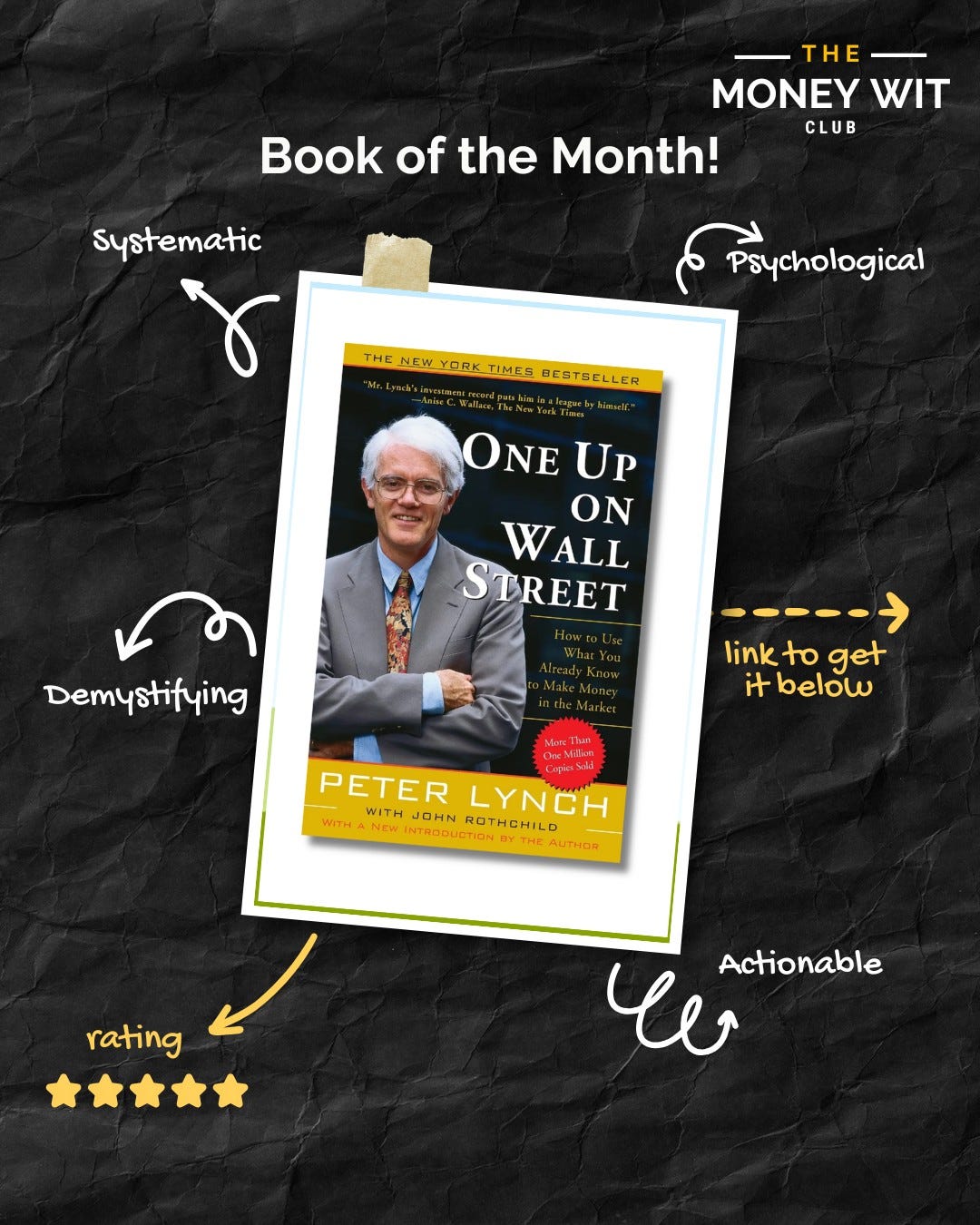
This week’s excerpt:
The person that turns over the most rocks wins the game. And that's always been my philosophy.
The Nugget:You already have an edge — you live in the real world. Lynch made his biggest wins by spotting great companies as a regular customer, long before Wall Street showed up.
Action: List three products or stores you've used this month that impressed you. Check if any are publicly traded. If one is, pull up its ticker and spend 15 minutes reading the basics.
Get the Book Here and let’s discuss in the club!
HOW WE HELP YOU WIN WITH MONEY:
Because financial freedom isn't luck; It's a learnable skill.
FOR INDIVIDUALS
LEARN - Master the fundamentals that matter
• Beat The Odds Workshop – Learn how the top 1% think about money and markets
• Personal Finance Lab (PFL) – Build the systems that create lasting wealth
CONNECT - Join Nigeria's sharpest money minds
• The Money Wit Club – Full community access plus personal guidance and accountability
GROW - Get the personal support that moves the needle
FOR CORPORATES
PARTNER - Strategic collaboration that drives impact
• CSR Sponsorship – Partner with us on financial literacy initiatives that matter
• Custom Corporate Programs – Tailored financial education designed for your organization
• Brand Partnership – Connect with our engaged community of 5000+ finance enthusiasts.
Ready to level up? Send us an email via info@themoneywitclub.com.
Ongoing club deals


We were live this morning.
Access Holdings just made ₦1 trillion in profit, but you aren't getting a dividend. Here is the hidden CBN math every investor needs to see before the 2027 deadline.
In this video, Oler Oladele breaks down the three biggest financial shifts of the week. From the regulatory "red flags" at Access Holdings to the massive 0% China-Africa tariff opportunity, we explain what these moves mean for your pocket. We also dive into the "AI Value Chain" to explain why Samsung is now a $1 trillion company and how you can find the "hidden monsters" of the AI economy.
Watch, learn, and share with a friend.
Watch here and don't forget to share with someone who needs to see it.
Did you enjoy reading this? Help spread the message by forwarding to at least 10 of your contacts.
Was this email forwarded to you? Subscribe here.
We host weekly money discussions live on our YT channel… visit our channel
Want to advertise with us? Email business@oleroladele.com
At the Money Wit Club, we provide you with opportunities to invest in high-value companies with potential to help you yield the highest returns on your investments.
Watch full interview here
Click the button below for more information on how to join the club.
Thanks for reading this week’s letter. We love having you here. Got thoughts on today’s edition? Hit reply and let us know! See you next week with more Global news and money wisdom.